

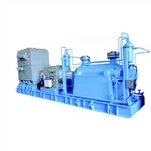
A magnetic pump is a pump that works on the principle of magnetic coupling transmission. It transfers power from the motor to the impeller of the pump through a magnetic coupling, thereby achieving liquid delivery. The key feature of the magnetic pump is its seal-free design, which completely isolates the internal liquid of the pump from the outside world, avoiding leakage problems, and is particularly suitable for conveying dangerous, toxic or corrosive liquids.
Main components of a magnetic pump
Motor: Provides driving power.
External magnetic rotor: Connected to the motor shaft and rotates with the motor.
Isolation sleeve: Located between the inner magnetic rotor and the outer magnetic rotor to ensure that the liquid in the pump chamber is isolated from the outside world.
Inner magnetic rotor: Connected to the impeller, it rotates synchronously with the outer magnetic rotor through magnetic coupling.
Pump body and impeller: Responsible for the suction and discharge of liquid.
Advantages of magnetic pump
Leak-free design: Since there is no mechanical seal, the liquid will not leak, and it is suitable for occasions requiring high sealing.
Low maintenance: No seal wear, small maintenance workload.
High safety: Suitable for conveying toxic, flammable, and corrosive liquids to ensure the safety of operators and the environment.
Disadvantages of magnetic pumps
Limited application range: Not suitable for conveying liquids containing solid particles, as solid particles may cause wear of the isolation sleeve.
Higher price: Due to the complex design and high material requirements, the cost of magnetic pumps is relatively high.
Temperature limitation: Some high-temperature liquids may affect the performance of magnetic coupling.








 Whatsapp:
 Wechat: +8613953308355